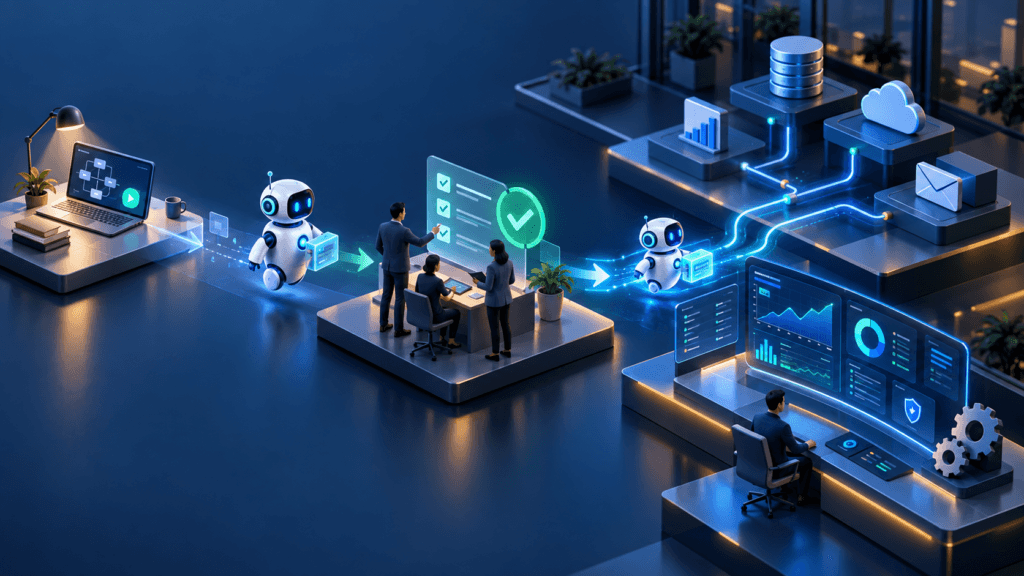

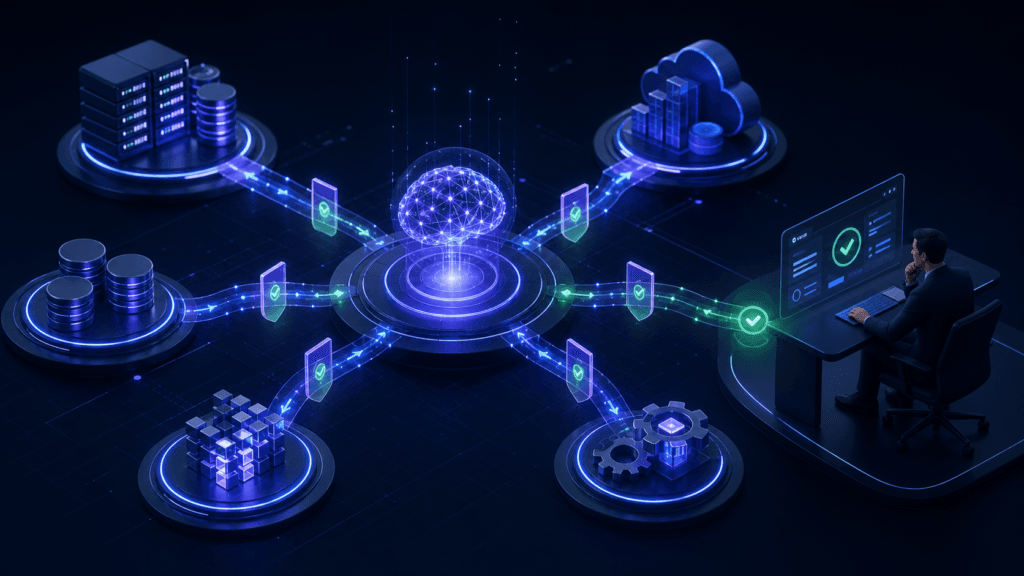
AI agent enterprise integration India projects succeed when the agent is treated as a controlled workflow participant, not as a model with unrestricted access to production systems. The practical architecture is a reasoning layer connected to narrowly scoped tools, an authorization gateway, reliable workflow state, audit logs, and human approval for actions that affect money, customers, permissions, or permanent records.
This guide explains how to connect an AI agent to ERP, CRM, databases, document stores, email, and internal APIs without turning every model error into a business incident. For the broader business case and agentic patterns, begin with our Agentic AI guide for Indian businesses. For a standards-based approach to exposing tools, see our Model Context Protocol guide.
Key Takeaways
An enterprise AI agent should never connect directly to unrestricted production credentials; every action should pass through a controlled tool or service boundary.
Read access, draft creation, external communication, financial actions, and irreversible changes require different permission and approval policies.
Reliable integrations use idempotency, bounded retries, durable workflow state, validation, and explicit rollback or compensation paths.
The agent lifecycle continues after launch: evaluations, monitoring, version control, incident response, and retirement are production requirements.
Indian organisations processing personal data should include applicable DPDP obligations in the design review rather than treating privacy as a launch-day checklist.
The Reference Architecture: Five Layers, Not One Model Call
A production agent integration is easiest to reason about as five layers. The interaction layer receives a user request or business event. The orchestration layer plans steps and holds workflow state. The tool gateway validates parameters, permissions, and policies before a call reaches a business system. The system layer contains ERP, CRM, databases, document stores, and internal services. A cross-cutting control plane records traces, evaluations, costs, approvals, and incidents.
The model belongs in the orchestration layer. It should propose an action such as “create a draft opportunity update” or “request invoice approval.” A deterministic service then checks whether that tool is allowed, validates the structured input, applies the current user’s scope, and records the result. This separation keeps authorization and business rules outside probabilistic model output.
How to Connect ERP, CRM, Databases and Internal APIs
| System | Preferred integration | Safe starting permission | Failure path |
|---|---|---|---|
| CRM | Versioned REST API plus webhooks | Read records and create drafts | Queue failed updates and request review |
| ERP | Supported service API or integration queue | Read transactions; propose changes | Reconcile against source and escalate exceptions |
| Database | Read-only views and approved stored procedures | Read a limited schema | Reject unknown queries; never fall back to broad SQL |
| Document store | Search/retrieval API preserving access controls | Retrieve only documents the user can access | Return “insufficient evidence” instead of guessing |
| Email or messaging | Provider API with separate draft/send tools | Create drafts | Require approval before external delivery |
| Internal API | Purpose-built tool contract or MCP server | One narrow business capability | Validate input and return typed errors |
Avoid wrapping every legacy endpoint as a separate agent tool. Tools should represent business capabilities—such as get open invoices or create a support escalation—with clear descriptions, typed inputs, and bounded outputs. A smaller, purposeful tool set improves both security and tool-selection accuracy.
Authorization: Give the Agent Less Access Than the User
Least privilege is the baseline. Use a dedicated workload identity, short-lived credentials, per-tool scopes, and user-context checks where the agent acts on someone’s behalf. The official MCP authorization guidance recommends least-privilege scopes, token validation, secure storage, HTTPS, and avoiding credentials in logs. Its security best practices explicitly reject token passthrough because it breaks audience boundaries and auditability.
- Separate read and write tools. A tool that retrieves a customer should not also update that customer.
- Preserve user context. The agent must not retrieve records the requesting user could not access directly.
- Validate every tool input. Use schemas, allowlists, length limits, and business-rule checks before execution.
- Keep secrets outside prompts and memory. Credentials belong in a secret manager and should be redacted from traces.
- Require step-up approval. High-impact actions should produce a preview that a named human approves.
Human Approval by Risk Level
| Action | Typical risk | Default policy |
|---|---|---|
| Read a permitted record | Low | Allow and log |
| Draft an internal summary | Low | Allow with source links |
| Update a reversible CRM field | Medium | Allow only within bounded fields and retain history |
| Send an external message | Medium | Create draft; human approves send |
| Approve payment, refund, access, or deletion | High | Named human approval plus policy checks |
| Unbounded code or administrator action | Critical | Disallow or isolate in a sandbox |
This follows the principle in the OWASP AI Agent Security Cheat Sheet: apply least privilege, validate external inputs, separate decision-making from irreversible execution, and retain human oversight for high-impact actions.
Reliability: Design for Duplicate Calls and Partial Failure
Agents retry, tools time out, and downstream systems occasionally accept a request before returning an error. Therefore every write tool needs an idempotency key so the same logical action cannot create duplicate invoices, tickets, messages, or refunds. Store workflow state outside the model context, cap retries, and send exhausted work to a review queue.
- Idempotency: one business action produces one durable identifier.
- Typed errors: distinguish retryable timeouts from validation failures and denied permissions.
- Compensation: define how to reverse a completed step when a later step fails.
- Reconciliation: compare agent records with the source system on a schedule.
- Timeout and cost limits: stop loops that exceed allowed duration, tool calls, or spend.
Data Governance for Indian Deployments
Before connecting personal or commercially sensitive data, inventory what the agent can receive, retrieve, store, infer, and send to model providers. Record the business purpose, retention period, data owners, subprocessors, and deletion path. India’s Ministry of Electronics and Information Technology publishes the current Digital Personal Data Protection Rules and enforcement material; organisations should obtain legal advice on how those obligations apply to their specific processing.
Technical controls should include data minimisation, field-level redaction, tenant isolation, encrypted storage, restricted logs, and a policy defining whether prompts or outputs may be retained. A model provider’s general security statement does not replace your own data-flow review.
AI Agent Lifecycle Management
- Discover: document the current process, exceptions, owners, and baseline cost.
- Design: define tools, permissions, approval gates, failure paths, and success criteria.
- Evaluate: build a representative test set containing normal cases, edge cases, malicious inputs, and unavailable systems.
- Pilot: run in read-only or recommendation mode before enabling writes.
- Roll out: expand permissions and volume gradually with rollback controls.
- Monitor: track task success, incorrect actions, escalations, latency, cost, tool errors, and policy violations.
- Version: record the model, prompt, tool definitions, retrieval configuration, and policy set behind every release.
- Retire: revoke credentials, archive required audit evidence, remove data, and redirect dependent workflows.
The NIST AI Risk Management Framework organises continuous risk work around govern, map, measure, and manage. That is a better mental model for agent lifecycle management than treating governance as a one-time approval.
What to Monitor in Production
Dashboard “uptime” is not enough. An agent can be available while making low-quality decisions. Monitor business and safety outcomes together:
- task completion and verified correctness;
- human escalation and override rates;
- unauthorised or blocked tool attempts;
- tool errors, retries, duplicate prevention, and reconciliation differences;
- latency and model/tool cost per completed task;
- prompt-injection and adversarial-test results;
- performance by workflow type, language, customer segment, and data source.
An Illustrative Integration: Lead Qualification Without Autonomous Email
Consider a B2B lead-qualification agent. A form event creates a workflow. The agent reads the submitted fields, retrieves permitted firmographic data, and scores the lead against an approved rubric. It can create a CRM draft, assign a suggested owner, and prepare a personalised follow-up. It cannot send the email or change opportunity value without approval.
This design produces immediate operational value while keeping customer-facing communication under human control. Once evaluation data shows consistently safe drafts, the organisation can selectively automate low-risk segments instead of granting blanket autonomy.
Build, Buy, or Use a Hybrid Approach?
Buy when the workflow is standard, connectors are proven, controls are visible, and your process does not create competitive advantage. Build when integration with proprietary systems, unusual decision logic, or strict control requirements dominate the project. A hybrid approach is common: use a managed model and orchestration framework, while owning the tool gateway, business rules, evaluation set, and operational data.
Quinoid’s AI development services and custom software development practice help teams design these integration boundaries before implementation begins.
Enterprise Integration Checklist
- One named owner for the workflow and each connected system
- Documented data flow and applicable privacy review
- Narrow tools with typed inputs and outputs
- Separate read, draft, write, and irreversible actions
- Short-lived credentials and per-tool authorization
- Durable state, idempotency, bounded retries, and reconciliation
- Human approval for high-impact actions
- Representative evaluation set and adversarial tests
- Production metrics, alerts, rollback, and incident ownership
- Version and retirement plan
Frequently Asked Questions
Can an AI agent integrate with a legacy ERP that has no modern API?
Usually, but the safest route is to build a controlled integration service around supported database views, file exchanges, queues, or existing service interfaces. Browser automation should be a last resort because screen changes create fragile failures.
Should an AI agent have direct database access?
Prefer a service or tool layer. If direct access is unavoidable, begin with read-only views and approved stored procedures rather than general SQL or table-wide write permissions.
Is MCP required for enterprise agent integration?
No. A well-designed function-calling or service interface can work. MCP is useful when the same tools must be discoverable across multiple compliant clients or model providers.
How long does an enterprise integration pilot take?
The schedule depends more on system access, data quality, approval design, and evaluation preparation than on the model. A narrow pilot using one or two well-documented APIs can move quickly; legacy systems and regulated actions require longer validation.
What should be automated first?
Start with a high-volume process that has clear outcomes, reversible actions, accessible data, and a human exception path. Avoid beginning with payments, account deletion, or broad administrator access.
Conclusion
AI agent enterprise integration India projects become dependable when authority is earned in stages. Start with read access and recommendations, prove performance against representative cases, add controlled write tools, and retain human approval wherever an error could create material harm.
The goal is not maximum autonomy. It is a measurable workflow that connects safely to real systems, fails visibly, and improves under disciplined lifecycle management.
Put these ideas into practice
Explore where AI could help your business.
Discuss your workflow, available data, and the result you want before deciding what to build.