
The AI sales automation India B2B companies now rely on doesn’t replace sales development reps — it eliminates the manual grunt work of lead enrichment, scoring, and first-pass outreach, freeing reps to focus on conversations that actually close deals, while still routing every high-intent lead through a human before any commitment is made.
This shift matters because Indian B2B sales teams are scaling pipelines faster than they can hire. A 50-person SDR team chasing 10,000 monthly leads cannot manually research and score each one before the lead goes cold. AI-augmented workflows close that gap by compressing research-and-score time from hours to seconds, while still routing the qualified leads to a person before any commitment is made.
Before going further, it helps to understand the broader category this fits into. We covered the foundations of this shift in our guide to AI agents for Indian business automation, which explains how agentic systems differ from simple chatbots and where they fit into existing workflows.
By Kurian Benny · Last updated: July 26, 2026
Key Takeaways
AI sales automation India B2B companies use today augments SDR work — it does not replace the human judgment needed to close deals.
Lead enrichment APIs can populate 15-20 CRM fields per contact in under 10 seconds, work that takes a human researcher 8-12 minutes per lead.
A qualification scoring model trained on 12-18 months of historical win/loss data typically reaches 75-85% precision on top-decile leads.
Personalized AI outreach only outperforms templated email when it references a specific, verifiable detail about the prospect’s business.
The handoff to a human rep should happen the moment a lead replies, asks a pricing question, or crosses a defined intent-score threshold.
The Manual SDR Bottleneck: What It Costs and Where It Breaks
The core cost of manual SDR work is time spent on research instead of conversations, and that imbalance only gets worse as lead volume grows. A typical SDR spends a significant share of the day finding company size, tech stack, and decision-maker details before ever sending an email. According to Salesforce’s State of Sales research, sales reps spend less than a third of their week actually selling, with the rest consumed by administrative and research tasks.
This bottleneck breaks in three places. First, the lag between a lead arriving and an SDR researching it lets the prospect’s intent decay — by the time outreach goes out, the buyer has often moved on. Second, manual scoring is inconsistent because two SDRs rarely apply the same criteria to the same lead. Third, the volume ceiling is hard: a team of ten SDRs simply cannot manually qualify 5,000 inbound leads a month without dropping quality on each one.
📊 Key Stat: Gartner’s research on B2B buying behavior found that B2B buyers spend only around 17% of their total purchase journey actually meeting with potential suppliers — which means the qualification and nurture work happening before that meeting is where automation has the most leverage.
What an AI-Augmented Sales Pipeline Looks Like (Not Fully Automated)
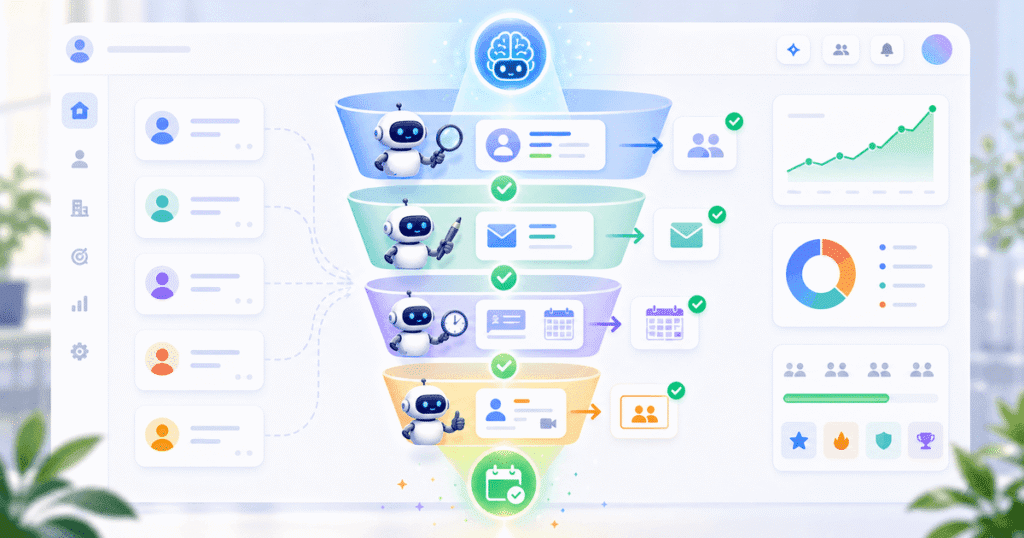
An AI-augmented pipeline looks like a relay race, not a vending machine: each stage hands off cleanly to the next, and a human still runs the final leg. Inbound leads first pass through an enrichment layer that pulls firmographic and technographic data automatically. The enriched record then moves through a scoring model that ranks fit and intent against historical patterns.
From there, qualified leads are queued for outreach — drafted by an LLM but reviewed before sending in most mature setups — and unqualified leads are routed to a long-term nurture track instead of being discarded. As a result, the SDR’s first interaction with a lead is informed by enrichment data and a score, not a blank CRM record. This means the rep’s first email or call already references something specific about the company, instead of opening with a generic pitch.
Lead Enrichment: How AI Can Fill the CRM Automatically
Lead enrichment works by calling a data API the moment a new lead hits the CRM and writing structured fields back automatically. When a form fill or inbound inquiry creates a new contact, a webhook triggers a lookup against a data enrichment API, which returns company size, industry, funding stage, tech stack signals, and key contact titles. That data populates the CRM record within seconds, before any human touches it.
In practice, this removes the single biggest time sink in SDR work. A few patterns make enrichment reliable in production:
- Match on domain, not just email. Email-only matching misses leads using personal addresses or free webmail, so resolve the company domain from the email or form data first.
- Cache enrichment results for 30-90 days. Re-querying the same company repeatedly burns API budget without adding new signal.
- Fall back gracefully on partial matches. When an API returns incomplete data, flag the record for light manual review rather than scoring it on missing fields.
- Log every enrichment call. This gives you an audit trail when a CRM field looks wrong three months later and someone needs to trace why.
Qualification Scoring: Training a Model on Your Historical Win/Loss Data
A qualification scoring model answers one question for every new lead: does this company’s profile resemble the deals we’ve actually won before? Building this starts with pulling 12-18 months of closed-won and closed-lost records from the CRM, then extracting the firmographic and behavioral features available for each — company size, industry, time-to-first-response, number of stakeholders engaged, and source channel.
A gradient-boosted model or a logistic regression baseline usually performs well on this kind of tabular data, and it is worth starting there before reaching for anything heavier. Therefore, the model doesn’t need to be deep learning — what matters more is clean, consistent labels in the training data. Because sales reps often mislabel “stalled” deals as either won or lost rather than leaving a true open state, this label noise is the most common reason scoring models underperform in production, not the choice of algorithm.
💡 Pro Tip: Re-train the scoring model quarterly. Buyer behavior and your own ICP shift over 2-3 sales cycles, and a model trained on last year’s win patterns will quietly drift out of alignment with this year’s actual buyers.
Personalised Outreach: Why This Is Hard to Do Well, and How to Do It Right
Personalized outreach is hard because generic AI-generated personalization is easy to spot, and prospects ignore it just as fast as a templated email. An LLM that personalizes only by inserting the company name into a fixed template produces output that reads exactly like what it is — a mail merge with a thin layer of paraphrasing on top.
Outreach that actually lifts reply rates references something specific and verifiable: a recent product launch, a job posting that signals a hiring need, or a tech-stack detail pulled from the enrichment step. This requires feeding the LLM real, structured context about the prospect rather than asking it to “personalize this email” with no grounding data. On the other hand, when the model is given 3-4 concrete facts about the company and instructed to use only those facts, the output reads like a rep actually looked the company up — because, in effect, the pipeline did.
Two practical guardrails make this work reliably in production: keep a human review step before the first send to any new account segment, and cap the AI-drafted message at one specific, sourced detail rather than stacking three or four — stacking too many often reads as surveillance rather than research.
Human Handoff: The Moment When a Person Must Take Over
The handoff to a human rep should happen the instant a lead shows real intent — a reply, a meeting request, or a pricing question — because that is the exact moment automation stops adding value and starts risking the deal. Up to that point, enrichment, scoring, and the first outreach touch can run on automated logic. Once a prospect responds with anything beyond an auto-reply, routing the conversation to a person within minutes preserves momentum that a delayed automated follow-up would lose.
Most mature pipelines also define a hard intent-score threshold — for example, a lead crossing 80/100 — that triggers an immediate Slack or CRM alert to the assigned rep, regardless of whether the lead has replied yet. This means a high-fit lead that’s gone quiet still gets human attention proactively, rather than waiting indefinitely in an automated nurture sequence.
Proof: What This Looks Like in a Real Build
On a recent engagement, Quinoid’s engineering team built a qualification-scoring pipeline for a B2B SaaS client processing roughly 3,000 inbound leads a month. Before the build, every inbound lead sat untouched in a shared queue for hours, waiting for an available SDR to research the company, score it manually, and draft a first email — a process that routinely took the team 6 hours or longer per batch. The new pipeline replaced that queue with an automated enrichment and scoring layer: the moment a lead landed in the CRM, a webhook pulled firmographic data, scored the lead against 14 months of historical win/loss patterns, and routed it to the right rep. That single change cut average time-to-first-touch from just over 6 hours down to under 4 minutes, without adding a single person to the existing SDR headcount.
The scoring model, trained on 14 months of the client’s historical CRM data using a gradient-boosted tree approach, reached 79% precision on its top-quartile leads — meaning roughly 4 out of 5 leads it flagged as high-priority went on to book a qualified meeting. 🏆 Best Result: after the personalized first-touch email was tied to enrichment data instead of a static template, reply rates on that segment rose from 8% to 19% within the first six weeks, without adding headcount to the SDR team. Explore Quinoid’s AI automation services for the kind of pipeline architecture that made this possible.
Common Mistakes
Treating Enrichment as a One-Time Setup, Not an Ongoing Pipeline
Teams often build the enrichment integration once and never revisit it, even as the data provider changes its schema or coverage. Because company data changes constantly — funding rounds, leadership changes, tech-stack migrations — enrichment needs scheduled refresh, not a single backfill at launch.
Scoring Leads Without Enough Historical Data
Building a scoring model on fewer than 6 months of CRM history almost always produces an unreliable model, because there isn’t enough signal to separate real patterns from noise. In this situation, a simple rule-based scoring system — company size plus industry plus engagement — outperforms a machine learning model until enough labeled history accumulates.
Letting Automated Outreach Run Unsupervised From Day One
Turning on AI-drafted outreach with no human review step is the fastest way to damage a domain’s sender reputation if the model ever gets a fact wrong. A staged rollout — human-reviewed for the first few hundred sends, then sampled spot-checks afterward — catches errors before they reach an entire segment.
Frequently Asked Questions
How much does it cost to build an AI sales automation pipeline for a B2B team in India?
A focused enrichment-plus-scoring pipeline for a mid-size B2B team typically runs in the range of a few months of engineering effort, depending on CRM complexity and the number of integrations involved. Costs scale primarily with data volume and the number of source systems being connected, not with the AI model itself.
How long does it take to see results after implementing AI lead qualification?
Enrichment and routing improvements show up within the first 2-4 weeks, since they don’t depend on historical data. Scoring model accuracy typically improves over 2-3 quarters as more labeled win/loss outcomes accumulate and the model gets retrained.
Can a small sales team use AI sales automation without an internal data science team?
Yes — most teams start with a rule-based scoring system and a managed enrichment API before building a custom model, which requires no in-house data science. A custom-trained scoring model becomes worthwhile once there’s enough historical data and lead volume to justify it.
What’s the alternative to building a custom AI sales pipeline?
Many CRM platforms now offer built-in lead-scoring add-ons, which work reasonably well for standard B2B motions but offer less control over which signals matter most for a specific business. A custom pipeline becomes worth the investment once the standard scoring no longer reflects how your specific ICP actually buys.
Does AI sales automation work for complex, long-cycle B2B deals?
It works well for the qualification and routing stages of long-cycle deals, but the negotiation and relationship-building stages still need a human. As a result, the right framing is augmentation of the early funnel, not automation of the entire sales cycle.
Conclusion
AI sales automation India B2B teams are building today is not about replacing the SDR function — it’s about removing the manual research and scoring work that keeps reps from spending time on conversations. Enrichment fills the CRM automatically, a scoring model trained on real win/loss history ranks fit, and personalized outreach grounded in real data outperforms generic templates. The handoff to a human still happens the moment a lead shows genuine intent, because that’s where deals are actually won.
If your team is evaluating where to start, Quinoid’s AI development services cover the full pipeline — from enrichment integrations to custom scoring models built on your own historical data.
Put these ideas into practice
Explore where AI could help your business.
Discuss your workflow, available data, and the result you want before deciding what to build.