
For most Python JavaScript AI hire India developers decisions, the right answer is to hire Python engineers for the model and data layer and JavaScript engineers for the product surface, since AI-integrated products are almost always polyglot stacks rather than single-language systems built entirely in one language end to end.
This split matters because hiring the wrong skill for the wrong layer is the single most expensive mistake we see Indian engineering teams make in 2026. A founder who hires three Python data scientists but no frontend engineer ends up with a notebook that never ships. A team that hires only JavaScript generalists ends up calling a third-party AI API with no ability to fine-tune, evaluate, or control cost. Both mistakes are avoidable once you understand where each language actually earns its place in an AI product.
We have staffed both sides of this stack for clients building AI-integrated SaaS, fintech, and HRTech products out of India. For a deeper look at how those stacks come together end to end, see our breakdown of the AI startup tech stack in India for 2026.
By Anand Nair · Last updated: August 17, 2026
Key Takeaways
Python remains the default language for model training, fine-tuning, and data pipelines because of its mature ML ecosystem.
JavaScript and TypeScript own the AI product surface — chat UIs, streaming responses, and edge inference at the browser layer.
Most production AI products in 2026 use both languages in different layers, not one language end to end.
Senior Python AI engineers in India command a meaningful salary premium over generalist backend developers because demand still outpaces supply.
Teams that hire the wrong language for a layer — for example, only Python with no frontend engineer — routinely stall at the prototype stage.
Why the Python vs JS Question Matters for AI-Integrated Products
This question matters because AI features split a product into two distinct technical layers that need different specialists. The model and data layer needs engineers who can build, evaluate, and serve machine learning systems. The product layer needs engineers who can render fast, accessible interfaces and stream model output to users without blocking the page.
Founders who treat “AI engineer” as one undifferentiated role end up over-hiring on one side. As a result, they either ship a model that never reaches a real user, or they ship a slick UI wired to an off-the-shelf API with no ability to improve accuracy or control inference cost over time. Getting the Python JavaScript AI hire India developers decision right early prevents both failure modes and saves a full hiring cycle later.
Python’s Dominance in AI/ML: The Ecosystem Advantage Is Real
Python dominates AI/ML hiring because its tooling ecosystem for training, fine-tuning, and evaluating models is simply more mature than any JavaScript equivalent. Major ML frameworks, vector database clients, and orchestration tools ship Python-first, with JavaScript bindings arriving later and often with fewer features.
This is not a stylistic preference. According to the TIOBE Index, Python has held the top or near-top spot among programming languages for several consecutive years, driven heavily by AI and data science adoption. Research teams publish in Python first, so new model architectures and fine-tuning techniques become usable in Python months before equivalent JavaScript tooling, if it ever arrives at all.
For an Indian engineering team, this means your data scientists and ML engineers should default to Python unless you have a specific, narrow reason not to. Trying to force model training into a JavaScript runtime to “keep one language” usually costs more in lost tooling than it saves in hiring simplicity.
JavaScript’s Role: Frontend Inference, Edge Inference, and Full-Stack Teams
JavaScript’s role in an AI product is to deliver model output to the user fast, often directly in the browser or at the edge, without a full round trip to a Python backend. Modern JS-based inference libraries can now run lightweight models directly client-side, which cuts latency for features like autocomplete, content moderation, and on-device personalization.
This matters for product experience in ways Python rarely touches. A chat interface that streams tokens, a recommendation widget that re-ranks instantly on scroll, or a voice feature that needs sub-100ms response — these are JavaScript and TypeScript problems, even when the underlying model was trained in Python. Edge functions, in particular, let teams run small AI tasks (classification, embedding lookups) close to the user, which is a JavaScript-native pattern that Python servers cannot replicate as cheaply.
Full-stack JavaScript teams also matter for speed of iteration. If your product team already ships in TypeScript across frontend and backend, adding a thin JavaScript layer that calls a Python inference service is usually faster than retraining the whole team in Python.
The Polyglot Reality: Most AI Products Use Both, in Different Layers
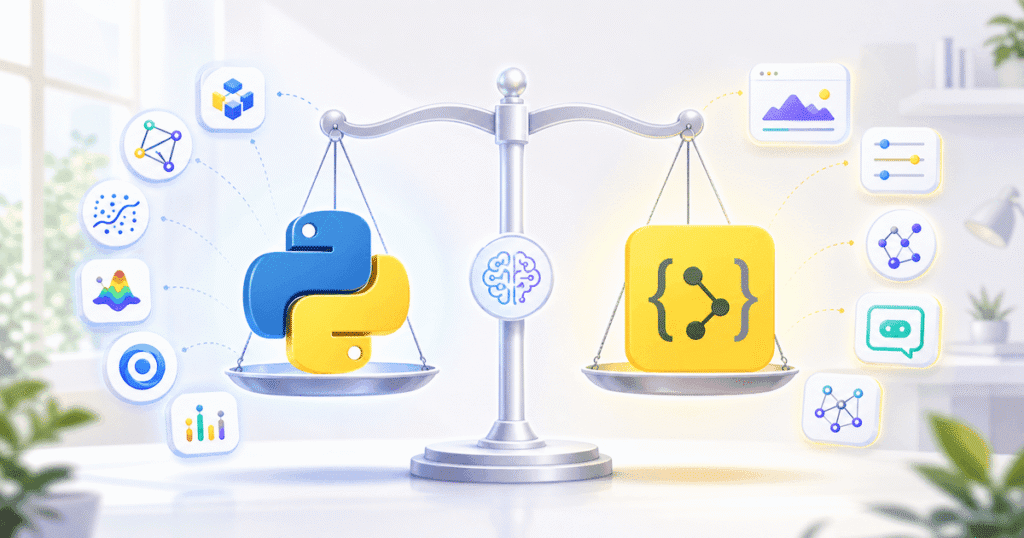
The polyglot reality is that very few production AI products are single-language end to end, because the model layer and the product layer have fundamentally different performance and tooling needs. A typical architecture looks like this: Python services handle training, fine-tuning, batch inference, and data pipelines; a JavaScript/TypeScript application layer handles the UI, real-time streaming, and orchestration calls to those Python services or to managed model APIs.
| Dimension | Python | JavaScript / TypeScript |
|---|---|---|
| Primary AI use case | Model training, fine-tuning, data pipelines, batch inference | UI, real-time streaming, edge/client-side inference |
| Ecosystem maturity for ML | Highest — most frameworks and research code are Python-first | Improving, but consistently lags Python for training workloads |
| Typical hire profile | ML/data engineer, applied AI scientist | Full-stack or frontend engineer with AI-integration experience |
| India hiring difficulty (2026) | High for senior fine-tuning/MLOps roles | Moderate — larger overall talent pool, fewer AI specialists |
| Where it runs | Backend servers, training clusters, notebooks | Browser, edge functions, Node.js backend |
Relative comparison of Python and JavaScript/TypeScript across four hiring dimensions for AI-integrated products in India: Python scores higher on ML ecosystem maturity and hiring difficulty, while JavaScript/TypeScript scores higher on talent pool size, matching the table above.
In practice, this means a well-staffed AI team rarely needs to choose one language. Instead, it needs to staff both layers correctly and make sure the handoff between them — usually an API contract or a streaming protocol — is owned clearly by one side.
Hiring in India: Python AI Engineer Supply vs Demand, 2026 Salary Benchmarks
Hiring Python AI talent in India in 2026 means competing for a smaller, senior-heavy pool, while JavaScript hiring draws from a much larger but less AI-specialized market. Demand for engineers who can fine-tune models, build evaluation pipelines, and operate MLOps infrastructure has grown faster than the supply of engineers with three or more years of applied ML experience, particularly outside the top five tech hubs.
📊 Key Stat: Senior Python-focused AI/ML engineers in India’s major tech hubs commanded annual salaries roughly 20-35% above generalist backend developers with comparable seniority in 2025-26 hiring data, according to compensation benchmarking from Glassdoor’s India machine learning engineer salary data.
JavaScript and full-stack TypeScript engineers remain easier to source at every seniority level in Bangalore, Hyderabad, and Pune, but fewer of them carry hands-on experience integrating production AI features. This means a generalist JS hire is faster to recruit but slower to ramp on AI-specific work like prompt evaluation, streaming architecture, or embedding pipelines, unless you budget time for that ramp-up.
💡 Pro Tip: If your roadmap needs both layers within the same quarter, staff the Python side first since it has the longer hiring lead time, then backfill JavaScript talent — the larger applicant pool there closes faster. For context on broader engineering hiring patterns in India, see our guide to building a remote engineering team in Bangalore.
Common Mistakes
Hiring Only Python Engineers and No Product-Side Developer
Teams that hire exclusively Python data scientists often build a working model that never reaches a user. A trained model sitting in a notebook delivers no business value until someone wires it into a real interface, and that wiring is a JavaScript and API-design problem, not a model-training problem.
Treating “AI Engineer” as a Single, Interchangeable Role
Job descriptions that ask for “AI engineer, Python or JavaScript” usually attract the wrong candidates for both layers. A Python ML specialist and a JavaScript integration engineer have almost no overlapping skill set, so combining them into one vague role filters out exactly the senior talent you need.
Underestimating MLOps and Evaluation Hiring
Many teams budget for a model-training hire but skip the MLOps or evaluation engineer who keeps that model reliable in production. Without that role, accuracy regressions and cost overruns go unnoticed until a customer complains, which is a far more expensive way to find the same problem.
Proof: A Real Polyglot Staffing Decision
On a recent fintech engagement, a client came to Quinoid planning to hire four Python engineers to build an AI-driven credit-risk scoring feature. After scoping the actual product surface — a loan-officer dashboard needing real-time score updates and explainable score breakdowns — the team restructured that single hire into two senior Python ML engineers for the scoring model and data pipeline, plus two TypeScript engineers for the dashboard and a thin API gateway layer connecting the two. The result: the scoring model reached a staging environment within six weeks, while the dashboard shipped in parallel instead of waiting for the model to be “done.” Splitting the hire this way also let the team backfill the two TypeScript roles from a larger, faster-moving applicant pool while the Python search ran longer for senior fine-tuning experience, exactly the sequencing this post’s Pro Tip recommends for teams facing the same two-layer hiring decision.
This is the same hiring pattern we apply across most AI development engagements where the client needs both a credible model and a shippable product in the same quarter.
FAQ
How much does it cost to hire a Python AI engineer in India in 2026?
Costs vary by seniority and city, but senior Python AI/ML engineers in India’s major hubs typically command a 20-35% premium over generalist backend developers with similar experience, reflecting the smaller pool of candidates with hands-on fine-tuning and MLOps experience.
How long does it take to hire a senior Python ML engineer versus a JavaScript developer in India?
Senior Python ML hiring usually takes longer because the qualified pool is smaller and more concentrated in a handful of cities. JavaScript hiring at comparable seniority typically closes faster simply because the overall applicant pool is larger.
Can one full-stack JavaScript developer handle both the AI integration and the UI?
Yes, for products that call a managed AI API rather than training custom models. A capable full-stack JavaScript or TypeScript engineer can integrate API calls, handle streaming responses, and build the UI without a dedicated Python hire, as long as the product does not need custom model training or fine-tuning.
Is it better to staff Python and JavaScript engineers in-house or augment with an external team?
It depends on how core the AI feature is to your product roadmap. Teams building a one-off feature often augment with external specialists to avoid a long permanent hiring cycle, while teams where AI is the core product usually move toward in-house ownership once the architecture stabilizes.
What if we can only afford to hire one language track right now?
Start with whichever layer blocks your nearest milestone. If you are validating model accuracy before committing to a product direction, hire Python first. If the model already exists via a managed API and you need to ship a usable interface, hire JavaScript first and add Python once you need custom model work.
Conclusion
The Python JavaScript AI hire India developers decision is not about picking a winner. Python earns its place in the model and data layer because its ML ecosystem is the deepest available, while JavaScript and TypeScript earn their place in the product layer because they deliver that model’s output to users fast, in the browser and at the edge. The teams that win are the ones that staff both layers deliberately instead of forcing one language to do a job it was never built for.
If you need to staff either side of that stack — or both, in parallel — without running two separate hiring cycles, Quinoid’s IT staff augmentation team can place AI-skilled Python and JavaScript engineers into your existing workflow within weeks, not months.
Put these ideas into practice
Find the right support for your team.
Share the roles, skills, and working arrangement you need to discuss relevant options.